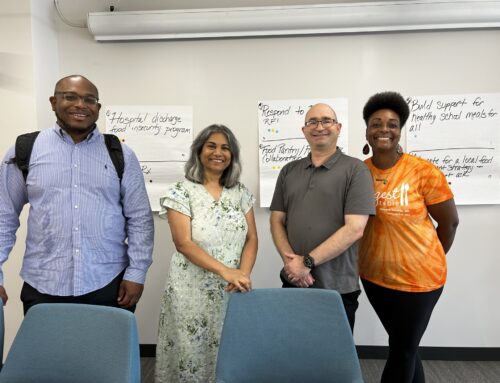
At the Horizon Foundation, we are privileged to work with a number of partners and fellows who have dedicated their personal and professional lives to advocating for a healthier and more equitable Howard County. Our community brings folks together from all different backgrounds – nonprofit leaders, health care professionals, service providers, teachers, farmers and, sometimes, community members who just want to help others and make a positive difference.
That’s Bertina Suber-Hanley. An aerospace engineer by trade, Suber-Hanley likes to help people and will go out of her way to do so. Her experience of helping others led her to a perhaps unlikely place – pursuing an Advancing Community Advocacy Fellowship with the Horizon Foundation – focusing specifically on housing justice.
The Foundation embarked on a new strategic plan several years ago that sought to understand the barriers that our residents, especially people of color and low-income communities, were facing in trying to live a vibrant and healthy life in Howard County. We conducted listening sessions, did polling, had an in-person community summit and knocked on thousands of doors. Then and now, we have found that housing issues surrounding affordability and quality are some of the top challenges our residents are experiencing.
It is no wonder why Suber-Hanley encountered so many people who needed a place to stay. In recent years, housing inventory has dropped while home prices have skyrocketed. The median sales price in Howard County is $630,000.[i] It’s no better for renters – the typical gross rent, including the cost of utilities, is over $2,100 per month, among the highest rents in the state.[ii] The hourly wage necessary to afford fair market rent for a 2-bedroom apartment in Howard County is $35.71. That means that a person would need 2.2 full-time minimum wage jobs and an annual income of $74,280 to afford fair market rent for a 2-bedroom apartment in Howard County.[iii]
While the affordability crisis is affecting all of us, this struggle is particularly burdensome for people of color in Howard County. Black and Hispanic residents are twice as likely to be renters compared to White residents, and renters are twice as likely to be cost burdened compared to homeowners.[iv]
As a health foundation, we know that where we live has an enormous impact on our quality of life and our ability to be healthy. We knew we had to address housing justice in our community, and we needed partners to do it. Suber-Hanley began her fellowship with the Foundation nearly two years ago, as the Foundation also welcomed its first two cohorts of housing justice grantees. Over time, Suber-Hanley and the partner organizations worked with us to learn about the housing landscape in Howard County and co-create policy solutions to make our housing system more fair, affordable and stable.
“Initially, coming into the fellowship with the various [funded partner] organizations, I learned about them and what they had to offer,” says Suber-Hanley. “What I wanted to get out of the fellowship was to assist people so that hopefully their housing needs would be more stable. [It became] not just about getting a place for them but helping them to stay where they were.”
But high costs are only part of the challenge. Through more door knocking and engaging with renters, we found that issues like junk fees – arbitrary fees for Wi-Fi, trash disposal, Amazon package deliveries or charging a fee for a mandatory web portal to pay rent each month – are rampant[v], as are issues with pests, mold, broken appliances and unresponsive landlords or property managers. Renters of color also have reported facing discrimination. Though many laws exist at the local level to protect renters, enforcement is weak. Many landlords don’t know their obligations, and many renters don’t know their rights or how to navigate the fragmented system of county services.
“That’s why my first task became looking into creating a landlord and tenant office,” says Suber-Hanley. “I knew that the Office of Consumer Protection existed in Howard County, but that they mostly handled mediation issues. I was interested in exploring the landlord and tenant office for Howard County so that it could be more of an enforcement arm for some of the terms that are in the lease, and to help tenants to keep them housed as opposed to unhoused.”
As Howard County prepares to seat a new County Executive and County Council in the coming weeks, advocates will be making the case to do just that – create a one-stop shop where renters can have their complaints heard and resolved, enforce corrective action where necessary and where both landlords and renters can get the resources they need to understand their rights and obligations under the law.
While much more work needs to be done to address housing issues in our community, accomplishing this goal would be a great first step in making renters’ lives easier – and would represent nearly two years of hard work of understanding Howard County’s housing landscape and working side-by-side with community organizations to push for change. And for Suber-Hanley, though her fellowship with the Foundation is coming to an end, the impact of that change will last well into the future.
[i] https://www.thebanner.com/community/housing/howard-county-real-estate-3LURTCXKVZFI3AJPXOO2Y74I6E/
[ii] https://www.thebanner.com/community/local-news/howard-county-census-home-ownership-XZZZGULB5BBEFIN7N2BWBMEIEA/
[iii] https://nlihc.org/oor/state/md
[iv] https://s3.amazonaws.com/hcls_wordpress_images/wp-content/uploads/2022/10/04151954/HCLS-Racial-Equity-Data-Report.pdf
[v] https://www.thebanner.com/community/housing/junk-fees-howard-county-rental-housing-costs-ZXBK5GC4PVF5ZJQA2FO4MQATVQ/